- calendar_today August 15, 2025
Natasha Henstridge’s Sil: Beauty, Terror, and DNA
Earlier this month, the Hollywood community was rocked by the passing of actor Michael Madsen, a veteran performer who, in recent years, had become best known for his stylized performances in Quentin Tarantino films like Reservoir Dogs and Kill Bill as well as the loquacious Donnie Brasco. The actor has a long list of fan-favorite and cult-classic roles, but it’s unlikely that too many tributes will mention Madsen’s turn in one of 1995’s more bizarre films: the sci-fi thriller Species.
Species was a relatively simple premise about a rogue black ops mercenary (played by Madsen) who, while working for the government, uncovers a secret program to splice human DNA with that of an extraterrestrial species with the goal of making a controllable but highly intelligent, supersoldier prototype. When the creature escapes into the wild and begins killing people in grotesque, ultra-violent ways, it becomes Madsen’s job to capture it before it can reproduce. As the 30th anniversary of Species rolls around this year, it’s time to give the film another look.
Species was an Odd Hybrid of Horror and Sci-Fi
The directorial debut of Roger Donaldson (No Way Out, The Bounty), Species combined aspects of body horror and sci-fi action with a streak of 1990s-era sexploitation. The film opens as the U.S. government receives a pair of transmissions from outer space: One is a detailed message about a newly discovered fuel source, while the other is an instruction manual about how to splice human DNA with alien DNA. It’s a no-brainer for the government, which contracts a team led by Dr. Xavier Fitch (Ben Kingsley) to engineer a prototype of what it hopes will be a highly intelligent but also highly controllable soldier. The result is Sil, a hybrid played in her early years by Michelle Williams.
Of course, Sil isn’t exactly what Fitch and his government handlers hoped for. In only a few months, Sil grows up to look like a preteen girl, but it quickly becomes evident that her mental growth is outpacing her physical development. She has violent nightmares, and disturbing clues emerge that she’s not a particularly controllable organism. When Fitch decides to end the experiment and kills Sil with cyanide in her containment cell, she escapes, propelling the story forward.
An international cast is assembled to hunt Sil, including Madsen’s Preston Lennox, a mercenary; Dr. Laura Baker (Marg Helgenberger), a molecular biologist; Dr. Stephen Arden (Alfred Molina), an anthropologist; and Dan Smithson (Forest Whitaker), a moody empath who can read Sil’s emotions. The quest to track Sil down leads the team all over the country and, ultimately, to Los Angeles, where Sil has grown into a young woman (Natasha Henstridge) and is searching for a mate. Sil is resourceful and intelligent and, perhaps most importantly, driven by instinct to mate and reproduce. In rapid succession, a train tramp, a nightclub patron, and a would-be lover are added to the body count, and the crew scrambles to find her before Sil can procreate and produce an army of offspring.
Species and the Creative Process Behind Its Alien Queen
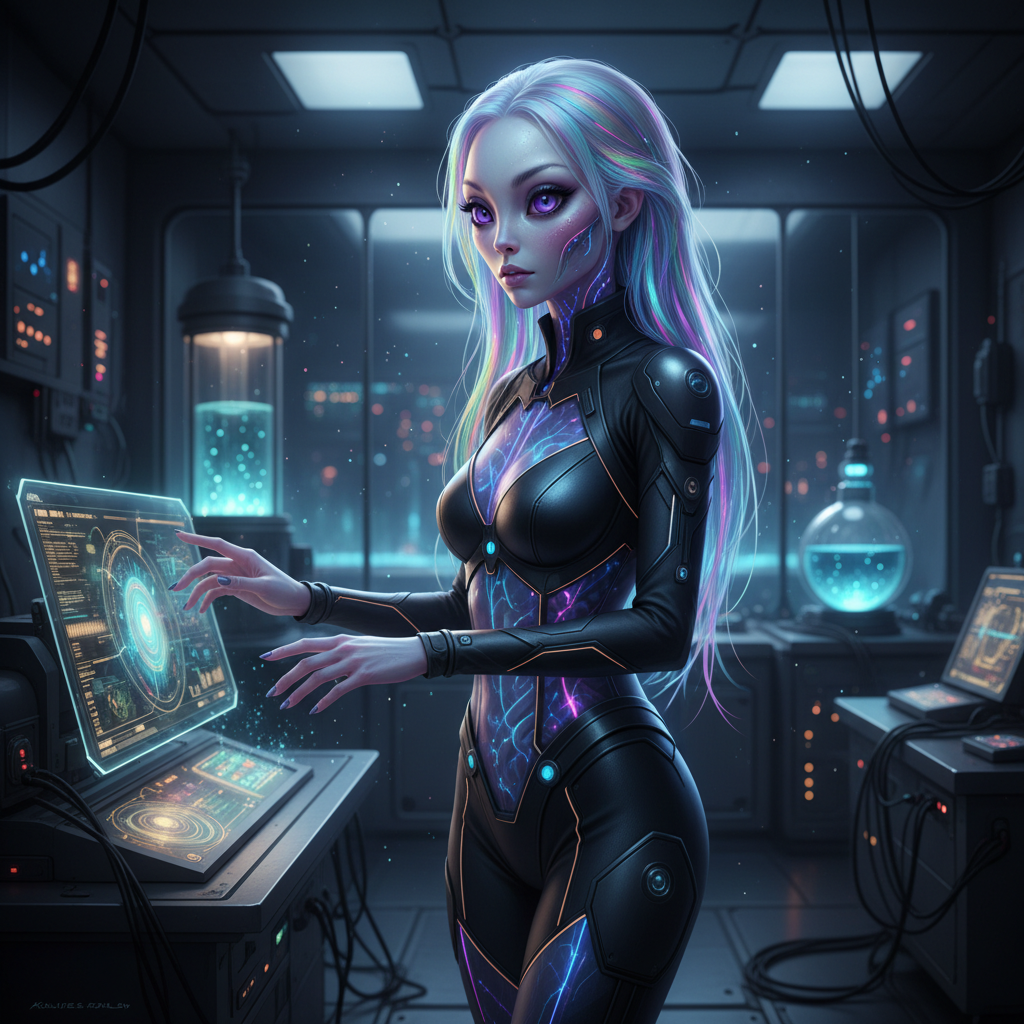
A key component to the design of Species was the film’s star—the half-alien/half-human woman known as Sil. Legendary surrealist artist H.R. Giger, best known for his work on the design of the xenomorph in Alien, also worked on Sil’s overall design. Giger called her “an aesthetic warrior, also sensual and deadly.” Giger’s vision was that Sil’s skin should be see-through, with her blood serving as an outer protective layer. In her final, adult form, she has what he described as “a glass body but with carbon inside.” The team built several transformation stages of Sil’s extraterrestrial DNA, but production limits restricted them to creating a cocoon with which Sil transformed, and the iconic white alien queen with which the film climaxes.
The Alien director David Fincher was so impressed with Giger’s work on Species that he later asked him to design both the Alien Queen and the Liquid-Men at the end of his own 1997 sci-fi horror hit, Alien 3. Giger was underwhelmed by the finished Species film. He later said that, although it was “technically brilliant,” the film was “completely brainless.” Giger also took umbrage at some of the production choices, saying that Species “followed Alien much too closely.” The creature’s punching tongue, Giger said, was reminiscent of the iconic Alien chestburster birth scene, and her incineration by flamethrowers at the film’s climax was a similar move to both Alien 3 and Terminator 2. Giger also claims that, after an incident during the filming of one of the death scenes, he intervened to have Sil killed by a gunshot to the head rather than fire.
The Reviews Were, Um, Mixed
In spite of its commercial success and cool creature design, Species received a mixed critical reception. Much of the dialogue was flat, and a large chunk of the supporting cast was underwritten or poorly directed. The villain, Dr. Xavier Fitch, was played by Ben Kingsley with a smugness that left his motivations feeling murky and immoral. Whitaker, as the empath who can read Sil’s emotions, spends much of the film lurking in the shadows and muttering things like “Don’t trust her.” The core themes of the film (bioethics, the possibility of alien contact, and women’s reproductive rights) are touched upon but not well explored. Even the title is kind of boring. (Try “species,” “kill species,” or “sil”). There is something to be said for the film’s disjointed collision of sci-fi and softcore horror. Screenwriter Feldman later revealed that he was partly inspired by an Arthur C. Clarke op-ed on the remoteness of possible extraterrestrial contact, with Clarke arguing that the chances of beings developing faster-than-light propulsion were statistically improbable. What if, Feldman speculated, extraterrestrials made contact with Earth and gave them blueprints not for a metal killing machine but for a synthetic human—a self-replicating organism of pure energy built with Earth’s DNA?
The film was a mission statement both of biohacking paranoia and an exercise in ’90s creature features. It’s unlikely that Species will ever be lauded as highly as Alien or The Terminator, but its shaggier edges and willingness to test the boundaries of science fiction horror lent it a loyal cult following for years after its release. Between Henstridge’s icily alien performance, Madsen’s charismatic grumpiness, and Giger’s surrealist designs, Species stands as a ’90s sci-fi B-movie that deserves a rewatch in 2024.
Species is now 30 years old. For a creature feature that tried to out-weird the most twisted of 1990s alien paranoia movies, it’s a time capsule of what science fiction used to look like when style was allowed to trump substance. It’s also a reminder of the strange, sometimes wonderful places that great actors can go and the unforgettable parts they can play along the way.